Easy Way to Convert Decimal to Hexadecimal
The number system is the system of representing numbers. There are different types of representations in the number system. They are Binary (Base – 2), Decimal (Base – 10), Octal (Base – 8), and Hexadecimal (Base – 16).
Decimal to hexadecimal conversion is the process of converting a decimal number to a hexadecimal number. The decimal number has a base value of 10 (0 to 9) and the hexadecimal has a base value of 16 (0 to 9 and A to F for 10-15).
The following table shows the representation of Hexadecimal, decimal and binary values:
| Hexadecimal Digit | Decimal Digit | Binary Form |
| 0 | 0 | 0000 |
| 1 | 1 | 0001 |
| 2 | 2 | 0010 |
| 3 | 3 | 0011 |
| 4 | 4 | 0100 |
| 5 | 5 | 0101 |
| 6 | 6 | 0110 |
| 7 | 7 | 0111 |
| 8 | 8 | 1000 |
| 9 | 9 | 1001 |
| A | 10 | 1010 |
| B | 11 | 1011 |
| C | 12 | 1100 |
| D | 13 | 1101 |
| E | 14 | 1110 |
| F | 15 | 1111 |
There are different ways to convert Decimal to Hexadecimal numbers. They are as follows:
Converting Numbers with the Integer part
Step 1: Take the decimal number as dividend and 16 as the divisor (hexadecimal number will have 16 as a base)
Step 2: Divide the dividend with the divisor and store the remainder in an array
Step 3: Now divide the quotient obtained from the above step by 16 and store the remainder in the array.
Step 4: Repeat the third step until the number is greater than zero.
Step 5: The final hexadecimal value will be the reverse order of the array.
Example 1: Let's consider a decimal number 450. We need to convert this decimal number to a hexadecimal number.
Solution:
Given: Decimal number = 450(10)
Step 1: 450/16 gives Q1 = 28 and R1 = 2
Step 2: 28/16 gives Q2 = 1 and R2 = 12 = C
Step 3: 1/16 gives Q3 = 0 and R3 = 1
Step 4: 0/16 gives Q4 = 0 and R4 = 0
Therefore, the hexadecimal value is 01C2(16)
Example 2: Convert 6096(10) to ________(16)
Solution:
Given: Decimal number = 6096(10)
Step 1: 6096/16 gives Q1 = 381 and R1 = 0
Step 2: 381/16 gives Q2 = 23 and R2 = 13 = D
Step 3: 23/16 gives Q3 = 1 and R3 = 7
Step 4: 1/16 gives Q4 = 0 and R4 = 1
Step 5: 0/16 gives Q5 = 0 and R5 = 0
Therefore, the hexadecimal value is 017D0(16) or 17D0(16)
Converting Numbers with Fractional parts
Step 1: Take the decimal fractional number and multiply it with 16 (hexadecimal number will have 16 as a base)
Step 2: Store the remainder in an array i.e. the integer part
Step 3: Repeat the above two steps until the number is zero.
Step 4: The final hexadecimal value will be the elements of the array.
Example 1: Convert 0.0568(10) to _______(16)
Solution:
Given: Decimal number = 6096(10)
Step 1: 0.0645 x 16 = 1.032 and R1 = 1
Step 2: 0.032 x 16 = 0.512 and R2 = 0
Step 3: 0.512 x 16 = 8.192 and R3 = 8
Step 4: 0.192 x 16 = 3.072 and R3 = 3
Step 5: 0.072 x 16 = 1.152 and R3 = 1
The fractional part is still not zero so it continues, now we can take up to 5 remainders
Therefore, the hexadecimal value is 0.10831…(16)
Converting Numbers with Both Integer and Fractional parts
Steps of both the integer part and fractional part are to be followed.
Example 1: Convert 256.00390625(10) to _________(16)
Solution:
Given: Decimal number = 256.00390625(10)
Let's perform the conversion on integer part:
Integer value = 256(10)
Step 1: 256/16 gives Q1 = 16 and R1 = 0
Step 2: 16/16 gives Q2 = 1 and R2 = 0
Step 3: 1/16 gives Q3 = 0 and R3 = 1
Let's perform the conversion on fractional part:
Fractional value = 0.00390625(10)
Step 1: 0.00390625 x 16 = 0.0625 and R1 = 0
Step 2: 0.0625 x 16 = 1.0 and R2 = 1
Step 3: 0.0 x 16 = 0 and R3 = 0
Therefore, the hexadecimal value is 100.010(16)
Indirect Conversion
In this type of conversion, we will convert the decimal number to a binary number or octal number and further convert it to a hexadecimal number by grouping digits.
Example 1: Convert 66(10) to _______(16)
Solution:
Given: Decimal Number = 345(10)
Convert the given decimal number to its binary form:
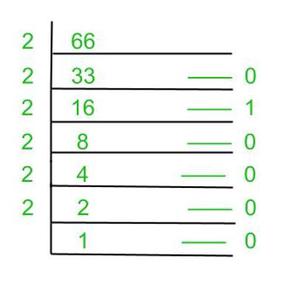
Binary Number = 1000010(2)
Now, Group 4 binary digits as one group and write its hexadecimal value
i.e. 0100 0010
Therefore, Hexadecimal Number = 42(16)
Source: https://www.geeksforgeeks.org/how-to-convert-decimal-to-hexadecimal/

Post a Comment for "Easy Way to Convert Decimal to Hexadecimal"